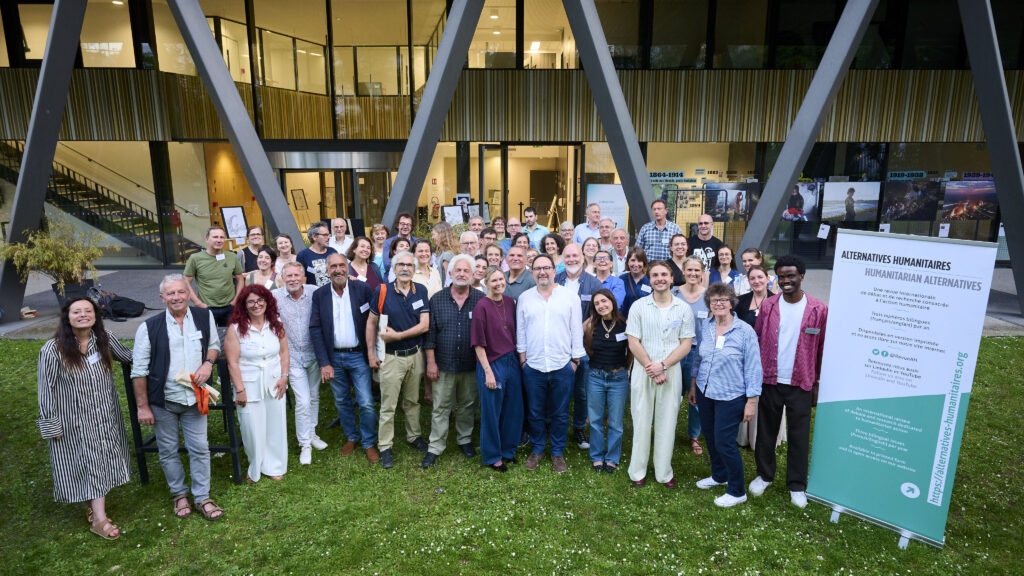
To celebrate its 10th anniversary, the magazine Alternatives Humanitaires took over the Red Cross Campus for an evening of reflection co-organized with the French Red Cross Foundation. We take a look back at this anniversary event, which brought together international researchers and practitioners for two round tables and art exhibitions, illustrating a decade of cross-fertilization of knowledge in the service of humanitarian action.
Alternatives Humanitaires, ten years of humanitarian thinking
Launched in February 2016, Alternatives Humanitaires is a bilingual (French/English) magazine dedicated to humanitarian action co-created by several foundations working on humanitarian action. Its ambition is to bring together researchers and practitioners in the sector, and to give greater international visibility to French-speaking humanitarian approaches in order to inform decisions, contribute to transformation, forge links and bring out new perspectives. Published three times a year, its articles are freely accessible online, based on the notion of the common good and open access to research.
The French Red Cross Foundation, at the heart of the adventure from the outset
The fact that the French Red Cross Foundation is hosting this anniversary event on its campus is part of a shared history. As one of the magazine’s founding partner members, it played a decisive role from the very start of the project. Prof. Jean-François Mattei, then President of the French Red Cross Fund – now the French Red Cross Foundation – gave a decisive impetus to the project through his reflection on the place of French-language knowledge on humanitarian action and its dissemination.
The dynamics of the Forum Espace Humanitaire (FEH) and the mobilization of several co-founding foundations were at the heart of the creation of this resolutely collective editorial project. It became an association jointly led by Benoît Miribel (Fondation Mérieux), Jean-Baptiste Richardier (Fondation Handicap International), Jean-Christophe Rufin (Fondation Action contre la Faim) and Jean-François Mattei/Virginie Troit (Fondation Croix-Rouge française), who were soon joined by an extended collegial governance. After two years of gestation, the first issue appeared in February 2016 under the pen of editor-in-chief Boris Martin, in natural continuity with Médecins du Monde’s former Humanitaire magazine. “A French-language magazine could only be international,” Virginie Troit reminded us, as scientific debate and the humanitarian sector know no borders. The magazine will be bilingual. Celebrating the magazine’s 10th anniversary here also means looking back at part of the Foundation’s history and the dynamics of the humanitarian sector in France.
Two spaces, one commitment
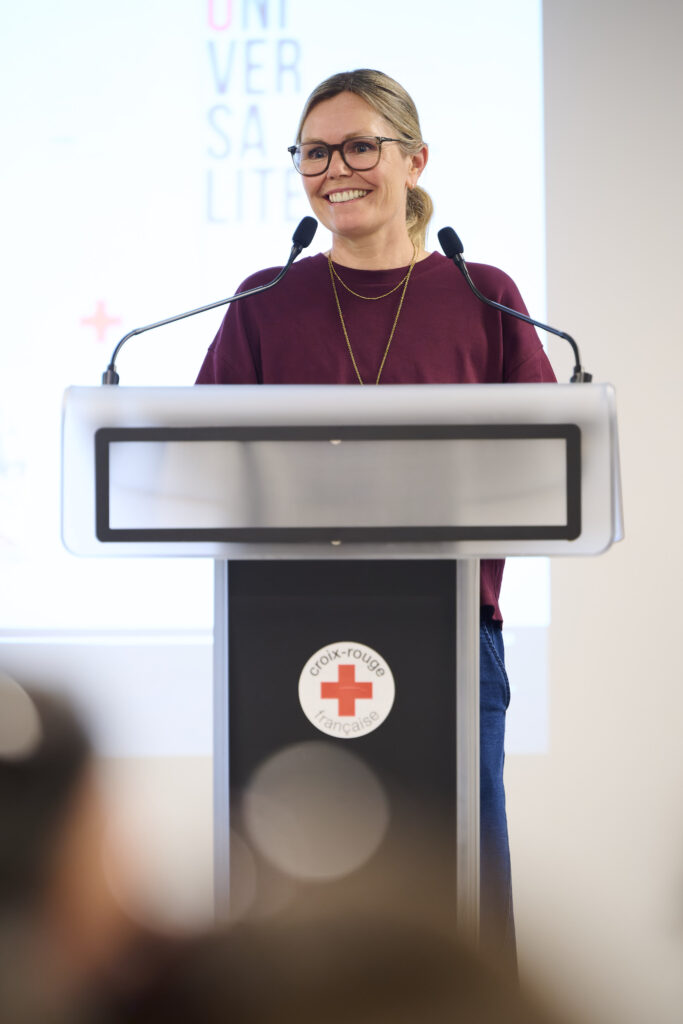
The evening opened with speeches by Virginie Troit, Executive Director of the French Red Cross Foundation, Jean-Baptiste Richardier, President ofAlternatives Humanitaires, and Boris Martin, Editor-in-Chief of the magazine.
The meeting then unfolded around two complementary areas. On the one hand, a space for debate, with two round tables bringing together contributors and researchers from a wide range of backgrounds. On the other, a creative space offering participants the chance to discover the work of artists and authors who, through their works, give a different view of humanitarianism: a selection of photographs published in the magazine since its inception, as well as original plates by cartoonist Brax.
Two round tables to embody ten years of commitment
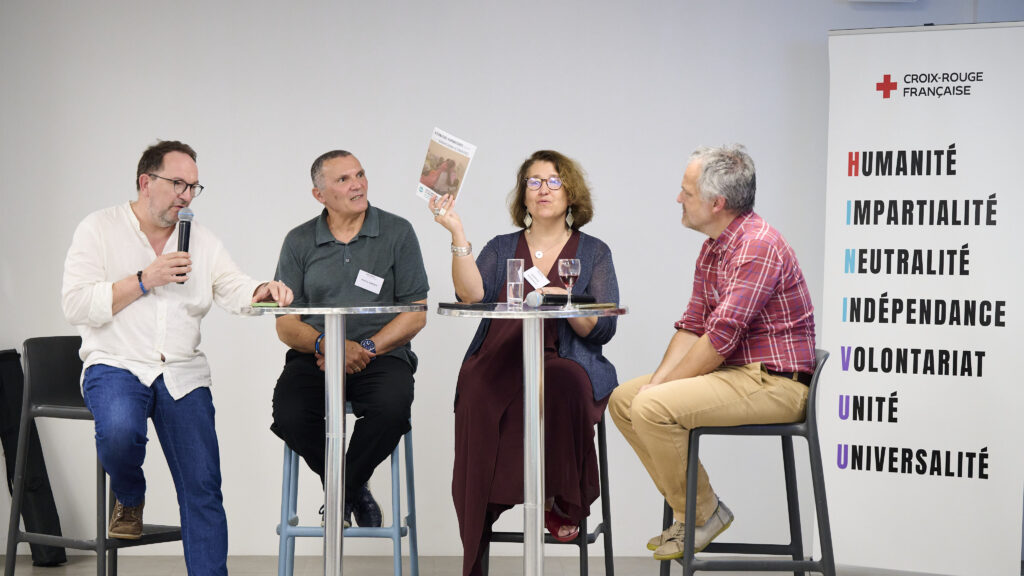
The first round table, moderated by Boris Martin, brought together Stéphanie Tchiombiano, Associate Professor of Political Science at Paris 1 Panthéon-Sorbonne, Vincent Léger, Research Officer at the French Red Cross Foundation and Doctor in Anthropology, and Pierre Gallien, Director of Impact, Information & Innovation at Humanité & Inclusion.
. All three co-piloted one of the last three issues of the magazine, and shared what it’s like to be involved withAlternatives Humanitaires: the challenges of collective work between researchers and practitioners, the lessons learned, and the dynamics that this collaboration continues to generate – embodying through these issues the people who are committed, in one way or another, to the magazine.
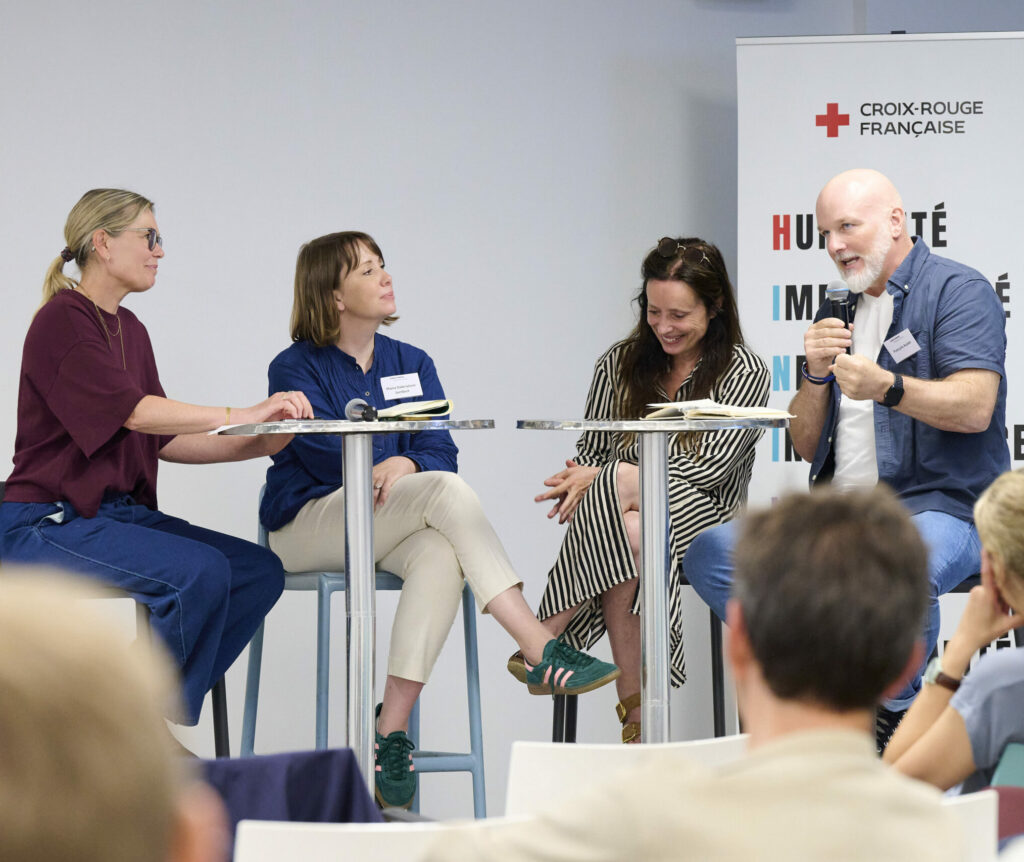
The second round table, moderated by Virginie Troit, brought together researchers from a variety of geographical and institutional backgrounds: François Audet, Professor at the Université du Québec à Montréal and Director of the Canadian Crisis and Humanitarian Aid Observatory (CCHAO); Françoise Duroch, Head of MSF’s Humanitarian Issues and Practices Research Unit (UREPS) in Geneva; and Maria Gabrielsen Jumbert, Senior Researcher at the Peace Research Institute Oslo (PRIO) and Director of the Norwegian Centre for Humanitarian Studies.
Each representing a different country and research tradition, they discussed the place and relevance of a bilingual magazine like Alternatives Humanitaires in international scientific and humanitarian debates, and what it brings to a community whose issues extend far beyond French-speaking borders.
A meeting worthy of a decade of collective commitment, faithful to the spirit that has animated Alternatives Humanitaires since its first issues: intellectual rigor, diversity of viewpoints and a shared conviction that reflection is inseparable from action.