
Transforming humanitarian and social action through research
Our three tools for action
1. The generation of new scientific knowledge
The Foundation supports research by awarding postdoctoral research grants, by developing research programmes with partners or in collaboration with academic institutions, and by awarding prizes to innovative or deserving researchers
2. Bringing diverse knowledge into dialogue
The Foundation disseminates knowledge through a range of publications and editorial projects tailored to different audiences. It contributes to the global debate by organising events or taking part in initiatives to disseminate and promote research, for the benefit of the most vulnerable.

3. Knowledge transfer
The Foundation is striving to move away from a ‘traditional’ approach of supporting the generation of scientific knowledge and subsequently promoting the application of that knowledge, towards an approach based on social research and development, which will enhance the potential for transformation and innovation arising from research findings.

The 5 stages of our work
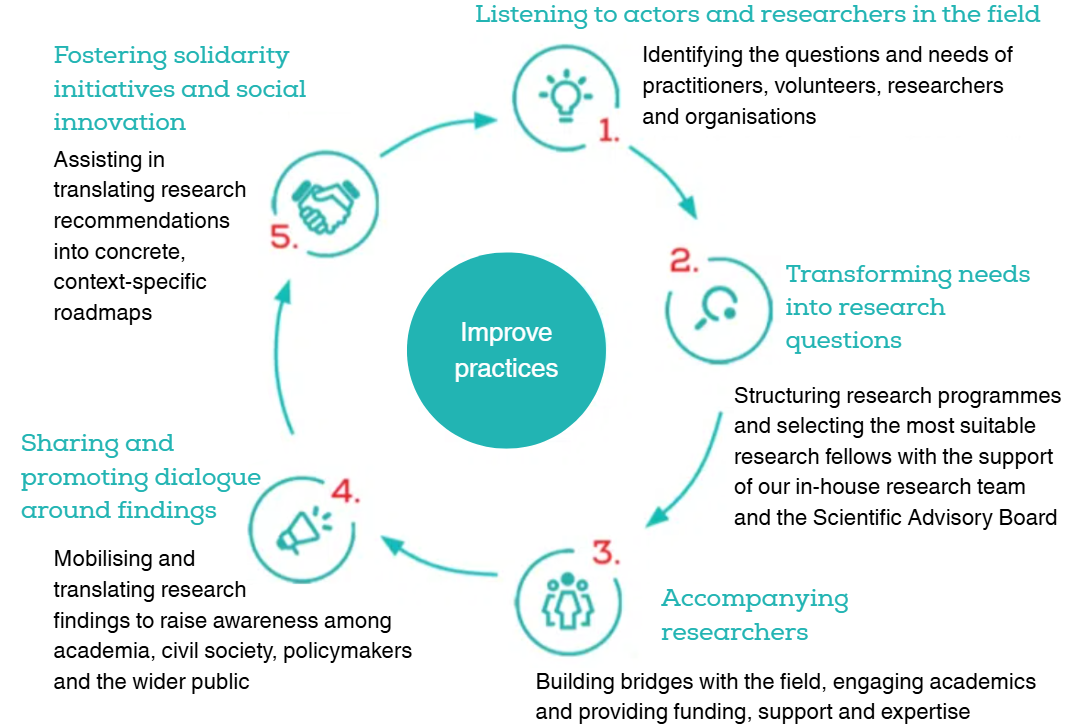
APRIS: the Red Cross Foundation’s method for turning research findings into concrete action
The Post-Research and Social Innovation Workshops (APRIS) create a forum for dialogue between researchers, practitioners and those directly affected, with a view to translating research findings into solutions tailored to the realities of humanitarian and social work.
Held several months after a research project, the APRIS workshops bring together:
- researchers,
- practitioners,
- volunteers,
- policy-makers,
- and those affected.
Through a collective intelligence approach, they enable:
- the pooling of knowledge and experience;
- the identification of levers for changing practices;
- the development of operational roadmaps;
- the support of social innovation tailored to local needs.
Examples of APRIS workshops
- Preparing local areas for disasters in the Hauts-de-France region;
- Engaging volunteers in exile in Marseille;
- Enabling older people to remain in their own homes in the Île-de-France region.
