

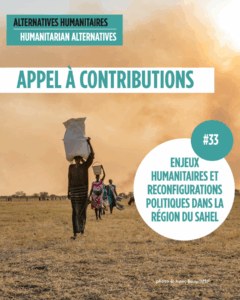
No. 33 Humanitarian issues and Political Reconfiguration in the Sahel Region
A special report co-edited by Camille Haye – a PhD student in political science at the University of Paris I Panthéon-Sorbonne and the Institute of African Worlds – and Boris Martin, editor-in-chief
Sahelian Africa appears to be a region of intertwined crises. In geo-climatic terms, the Sahelian belt refers to an area stretching across Africa from west to east, from Mauritania to the Horn of Africa. This region comprises states, many of which are characterised by weak institutional capacity and high levels of poverty, placing them at the bottom of international rankings according to the Human Development Index. These countries are thus described as ‘aid-dependent’, meaning they rely on international aid to maintain a balanced budget and a relatively satisfactory level of public services. Structural difficulties are compounded by geopolitical or climatic upheavals. The Sahel is marked by the phenomenon of seasonality, namely the alternation of wet and dry seasons. This phenomenon, exacerbated by global warming, repeatedly leads to humanitarian crises linked to flooding and lean seasons. Thus, the droughts of the 1970s helped to make the Sahel a key area for international intervention, with a significant influx of international non-governmental organisations (INGOs) to tackle famine. The role of humanitarian organisations and development NGOs in undertaking social missions was strengthened in the 1990s with the implementation of liberalisation programmes, with INGOs acting as intermediaries, or even substitutes, for public sectors weakened by structural adjustment programmes. The Sahel has also been a key testing ground for experimenting with nexus approaches and the ‘contiguum’ of aid. Faced with the paradox of ‘chronic emergencies’, the debate between emergency aid and development aid was particularly intense during the 2005 food crisis in Niger.
Whilst the multiplicity of mandates and the complementarity between agencies have long taken into account the necessary combination of emergency aid and long-term programmes, the shocks affecting the region—whose consequences are likely to be long-lasting—are reframing these questions in new terms. The war in Sudan, the clashes between Ethiopia and Eritrea, the conflicts in the Lake Chad and Central Sahel regions involving jihadist groups claiming allegiance to Islamic State or Al-Qaeda, and the rise of militias: these are all trends that have persisted for several decades and from which civilian populations suffer most. The Sahel region is thus firmly rooted in the paradigm of ‘complex humanitarian crises’—conflict-related humanitarian emergencies involving significant social breakdown. These conflicts inevitably bring their share of human suffering: population displacement, infrastructure damage, restricted access to social and health services, food crises, human rights violations, destruction of livelihoods, a general increase in vulnerabilities, etc. These protracted conflicts, whilst causing peaks of emergency, necessitate a long-term approach to aid: camps for forcibly displaced people are a case in point.
Long regarded as ‘humanitarian hotspots’, certain Sahel countries – depending on regional and international political circumstances – now ‘reject’ these international NGOs, whilst others lament their insufficient engagement. Whilst the security situation in certain regions has been hindering humanitarian access for several years, the rise to power of regimes employing anti-Western rhetoric in the central Sahel (Mali, Niger, Burkina Faso) is imposing new constraints on these NGOs. Cuts in aid from Western donors, including France (as a form of sanction against governments resulting from coups), have affected development aid channelled through NGOs. Whilst emergency aid was supposed to continue, the states thus ‘sanctioned’ by the withdrawal of international aid have in turn taken measures restricting NGOs. Thus, in November 2022, Mali banned NGOs funded by France from operating on its territory. The NGOs affected by these diplomatic skirmishes have had to choose between abandoning certain projects and seeking alternative funding.
The shock of 2025, with the sudden closure of the US cooperation agency – and the subsequent cuts to its funding, which account for some 40% of total aid – has already significantly exacerbated the crisis affecting this sub-region of Africa. This raises the question of how to meet the Sahel’s still-significant needs amidst drastic budget cuts. Contributions to this new Focus issue can thus build on the discussion begun in issue 30, Aid in Danger: After the 2025 Shock, the Consequences and the Response. Reflections on this international political context can be linked to domestic policy issues, particularly regarding the mistrust of Sahelian governments towards the humanitarian community. In Niger, in November 2024, the French NGO Acted had its operating licence revoked without justification, as did its Nigerien partner, the NGO Action Pour le Bien Être. The International Committee of the Red Cross office in Niger closed in June 2025 after 35 years of operation – at the request of the authorities and amid accusations of collusion with armed groups. This rhetoric is not new in this region affected by the actions of jihadist groups: in 2019 in Nigeria, Mercy Corps and Action Against Hunger (ACF) were forced to close their offices in the state of Borno, with the army accusing them of colluding with Boko Haram, even as ACF staff members were being held captive by that armed group. This issue will examine how humanitarian organisations can now negotiate the continuation or establishment of their programmes and, more broadly, their legitimacy in such climates of mistrust fuelled by the war on ‘terrorism’ or by political polarisation that equates Western NGOs with Northern governments.
The geographical scope of this special issue is the Sahel region in the broadest sense: thus, we do not intend to limit ourselves to the Western or French-speaking Sahel, nor to the states included in international alliances defining one Sahelian political space amongst others (G5 Sahel, Alliance of Sahel States). Articles focusing on the English-speaking countries of the region are strongly encouraged. We are seeking original contributions, written by humanitarian professionals, experts and academics, addressing issues such as:
- The difficulties of accessing ‘crisis’ zones for security or political reasons. Contributions may address the subject of negotiations with political authorities, non-state armed groups (militias, rebel groups, etc.), as well as the restrictions imposed on humanitarian access by anti-terrorism regulations.
- The challenges of the triple nexus / contiguum of aid and resilience in situations of chronic or protracted crises: food, health and climate crises, as well as crises involving displaced persons and refugees.
- The consequences of funding cuts by traditional donors (American, French, European, etc.) and the rise of ‘emerging’ donors (China, Qatar, Turkey, the United Arab Emirates, etc.).
- The consequences of authoritarian regimes coming to power using sovereignist rhetoric and the rise of anti-Western sentiment.
Submit an article
If you are a practitioner, researcher or observer in the international humanitarian and solidarity sector and would like to submit a draft article on this topic, please send an abstract outlining your research question, along with a provisional outline and a short biography (maximum two pages), by 18 May 2026 to the following email addresses: contact@alternatives-humanitaires.org; camille.haye@sciencespo.fr. You will receive a response by 5 June 2026 at the latest. Finalised articles – written in French or English – must be submitted by 21 September 2026 and be approximately 2,200 words (in English) or 2,400 words (in French), including footnotes. Around seven to eight articles will be selected for this Focus.
For each issue, we also consider articles on themes related to humanitarian and solidarity action that explore topics other than those proposed in the special feature. These may be published in the sections Perspectives, Transitions, Innovations, Ethics, Reportage or Opinion. We invite you to send us your proposals.
Objet :
Alternatives humanitaires
Caractéristiques :
• Format : 15 000 signes (espaces inclus)
• Date plan : 18 mai 2026
• Date rendu : 21 septembre 2026
Contact :