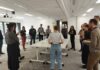
During this ninth edition of our “Pause-Culture-Recherche” at the Croix-Rouge Campus, Virginie Troit, Executive Director of the Foundation and recipient of a grant from the Franco-American Fulbright Commission as part of the NGO Leaders programme, reflected on her four-month stay (February to May 2025) at Columbia University in New York, where she worked on the project “Transforming the relationship between research and civil society to reconfigure humanitarian systems.”
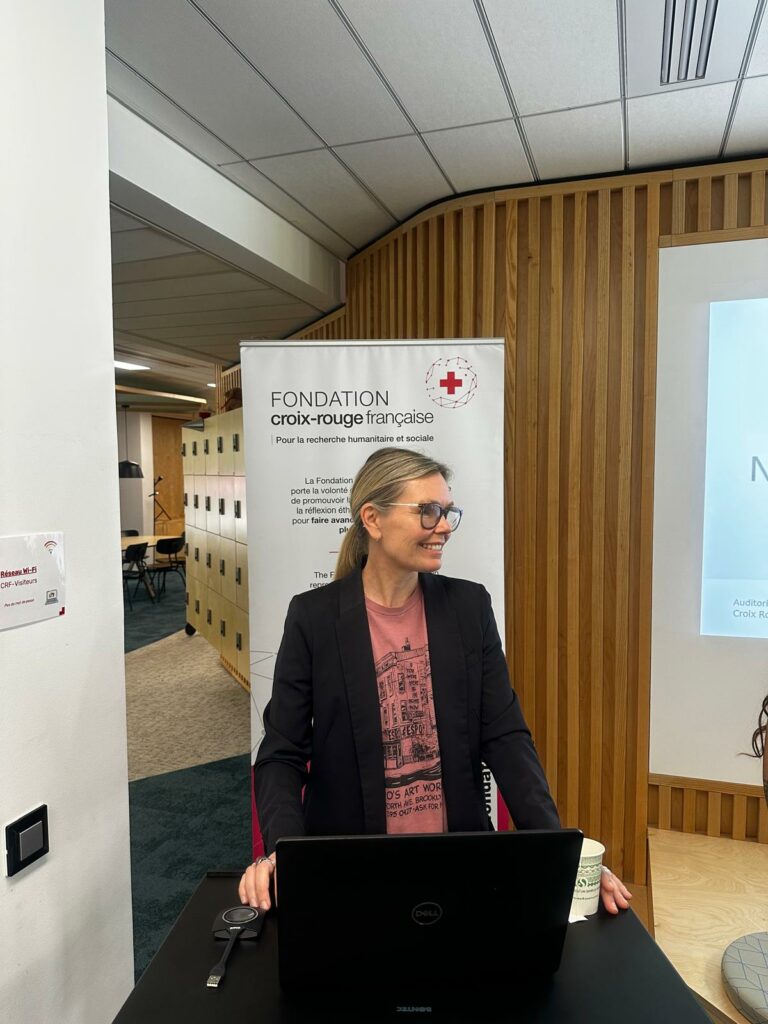
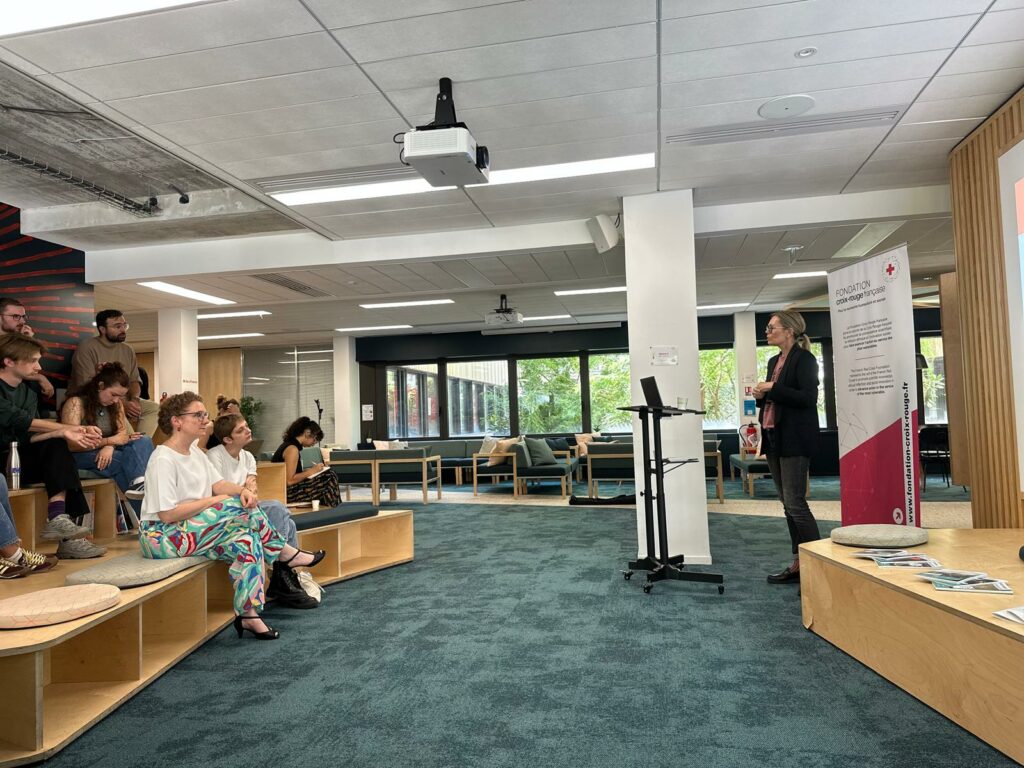
During her presentation, Virginie Troit recalled the recent major upheavals in the humanitarian and scientific sectors, and the growing challenges associated with their interaction. She shared her thoughts on the question: Why should we be interested in the relationship between universities and humanitarian organizations?
Virginie Troit traced the history of relations between the academic world and modern humanitarian actors. She discussed the ICRC’s close ties with the academic sector, particularly with legal experts, the emergence of the ICRC Review, and the importance of health/medical expertise in the creation of the League of Red Cross and Red Crescent Societies in 1919. This was the subject of Pause Culture Recherche No. 7 with Romain Fathi.
She explained how this link was strengthened with the rise of professionalization and accountability requirements in the 1990s. There is a real need for professional training and evidence-based data, activities that universities support. Then, starting in the 2000s, new entities dedicated to humanitarian knowledge began to form within NGOs, as think tanks or private consulting firms, or as dedicated university initiatives, a movement to which the Foundation belongs but with a rather unique model.
Her study in the United States aimed to better understand the dynamics between these two worlds. The country is a major player in the humanitarian field, home to numerous INGOs such as CARE, IRC, Mercy Corps, World Vision, national representations of transnational networks (MSF, Save the Children, Oxfam, Concern, etc.) and many of the most prestigious universities. She conducted 54 interviews with representatives from universities, American and international NGOs, international organizations, and donors.
She highlighted a fragmented academic landscape, without a single model, but one that has innovated, often structured around humanitarian epicenters such as New York and Washington. Following a brief mapping and presentation of initiatives developed at universities such as Columbia, Harvard, Tufts, John Hopkins, Yale, GW, and Fordham, she emphasized the richness of interdisciplinary approaches, the central role of pracademics (researchers who have become practitioners or vice versa), and the bridges between teaching and research activities in the field.
Finally, this “Pause-Culture-Recherche” offered valuable insight into the links between research and humanitarian action in a changing international context, raising the question of the economic model. It also opened up several avenues for reflection that are essential for France, where there are many resource centers but little coordination around real research hubs.
The question now is to examine the current state of affairs and the evolution of these areas of cooperation between universities, civil society, and public and private actors: What types of cooperation are currently in place? Are they at the policy or practical level? And what purposes do they serve in terms of innovation, advocacy, and the resolution of operational or institutional problems? Is there a place for innovative multi-stakeholder alliances at the intersection of two sectors under considerable pressure? What opportunities do cities such as Paris offer, as decision-making centers where students, researchers, national and international decision-makers, and humanitarian workers converge?
These are all questions that need to be addressed collectively in order to build lasting bridges between research and humanitarian action, at a time when the new funding landscape poses an immediate risk to areas that are sometimes perceived as non-priority, yet are increasingly essential for action, decision-making, and the fight against misinformation.
Find below all previous editions of our “Pause-Culture-Recherchese”: