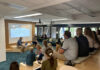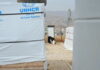
The Foundation’s next annual Rencontres will take place on October 28 at Sciences Po. This sixth edition will focus extensively on issues of concern to the humanitarian sector, which is facing numerous upheavals. Vincent Leger, who holds a Ph.D. in anthropology and serves as a research fellow at the French Red Cross Foundation, provides a detailed overview of the topics that will be addressed during the roundtables and debates scheduled throughout the day.
What topics will be discussed during the roundtable discussions that will take place during the morning session of this year’s Foundation Meetings?
Vincent Leger: We’ll start by discussing community participation in disaster response. This is a fundamental pillar of Disaster Risk Management (DRM), which involves actively engaging local communities in preparedness, early warning, relief efforts, and recovery, rather than treating them as mere passive recipients. We know that this participation is crucial, particularly because communities are always the first responders before official relief efforts arrive, and because prevention measures and emergency plans are better adhered to if they have been developed in collaboration with residents. But in practice, it’s not that simple. Two researchers supported by the Foundation will explain this to us. Khan Kouame, who holds a Ph.D. in communication sciences and is a faculty member and researcher at Alassane Ouattara University (Bouaké, Ivory Coast), conducted a study titled “Digital Resilience Practices in the Face of Flood Risks in the Abidjan District (Ivory Coast)” with support from the CMA CGM Foundation. As for Virginie Le Masson, who holds a Ph.D. in geography and is a research associate at the ODI think tank, she will present the results of her research, conducted with support from the Fondation de France, entitled: “Rethinking Disaster Risk Reduction (DRR) Through Social Action and Everyday Resilience Strategies in Chad.” The roundtable will also feature Guillaume Meugnier, director of territorial development at the French Red Cross, and sociologist Brice Molo, whose work focuses on the production and dissemination of knowledge about risks and disasters, with a particular focus on Africa.
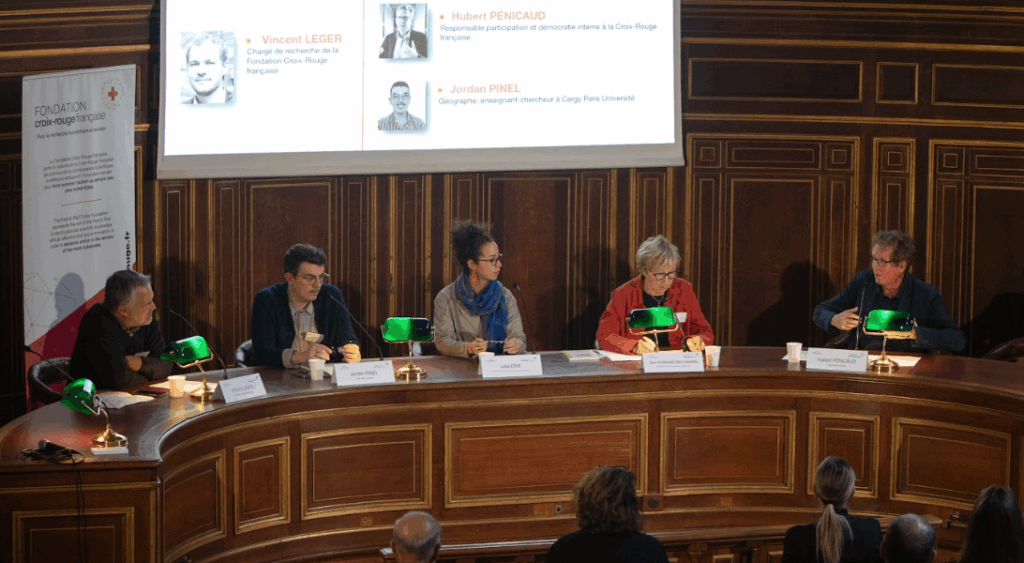
The second panel discussion of the morning will focus on the “localization of humanitarian aid.” For the past ten years, governments, donors, U.N. agencies, and international NGOs have been working to rethink their models in order to put local and national actors back at the center of the humanitarian response.
VL: The challenge is to move from a Western-inspired North-South model to a more complex model characterized by a decentralized and local response. This involves rebalancing roles and establishing more equitable partnerships with local actors. However, it is difficult to translate these ambitions into structural changes. The humanitarian system remains largely dominated by multilateral agencies and a small number of international NGOs. We will discuss this situation with, among others, sociologist Verena Richardier, who—with support from the Red Cross Foundation and the Government of the Principality of Monaco—conducted research in Senegal and Niger titled “On the Front Lines: Recognition and Professionalization Strategies for Humanitarian Frontline Workers.” To discuss this topic, Verena will be joined at the table by two professionals—Anne Bathily, co-founder of the CALLS network, and Anne-Lise Sève from the French Red Cross’s International Operations Department—as well as Ivorian historian Anicet Zran.
“The New Humanitarian Landscape” is now one of the Foundation’s five priority research areas. Can you explain what this new focus entails? And what led to its inclusion among the priority areas?
VL: Building on the concept of “humanitarian transition,” the notion of a “new humanitarianism” is essential for analyzing the radical transformations the international aid sector has been undergoing in recent years. These upheavals began in the 2020s with the health crisis and the outbreak of high-intensity wars. They intensified starting in 2025 with the historic decline in international funding and have put populations and actors to the test in the face of unprecedented and increasingly frequent disasters (mega-wildfires, heat waves, storms, floods, etc.).
The transition period was supposed to usher in a time of reform of the international system, an organized transfer of power between countries of the North and South, and a transformation of practices through innovation, inclusive approaches, and greater cooperation. But the “new normal” has drastically disrupted these dynamics. On the contrary, it is forcing the humanitarian sector—which faces new existential risks—to reinvent itself as crises multiply and funding becomes increasingly scarce. The “new reality” is manifesting itself through several shifts:
- An ideological shift that threatens its ethics, standards, and principles, and is manifested in particular through an unabashed disregard for international law, the withdrawal of major donors from international institutions, and harmful information campaigns;
- a political shift that leads to financial and institutional disengagement, hindering the transfer of resources and powers to local actors;
- an ecological shift driven by the effects of climate change and the reaching of several limits of the “Earth system,” raising fears of an escalation in needs across all dimensions of humanitarian action: food security and famine, conflicts and violence, migration and displacement, health and epidemics, poverty and exclusion.
To make sense of it, we must foster dialogue among the sciences and disciplines in every country, between research and professional communities, and among the public and private sectors, civil society, and the people who are affected, supported, and on the front lines of solidarity. Having the tools to gain a nuanced understanding of the dimensions and parameters of this new humanitarian reality should make it possible to maintain a dialogue—however fragile—among all stakeholders, to remain constructive without losing hope, and to move toward solutions without losing sight of what is essential, rooted in the principle of humanity.
This year, the Rencontres is introducing a new format for its discussions, moderated by the Research Award laureates. What topics will the discussions cover? And what makes this new format unique?
VL: To mark both the presentation of the50th research award and the launch of a publishing project featuring recipients of its research awards (you’ll learn more about this during the Rencontres), the Foundation has decided to invite its award winners to participate in the“1st Humanitarian Ideas Workshop.” The topic will be the “new humanitarian landscape.” The goal is not to take stock of the humanitarian sector, but to bring to light questions, blind spots, and avenues for research. In other words, the workshop aims to stimulate ideas and open up new avenues of research to support the transformations taking place in the humanitarian sector and social action. Hence the title of thisfirst edition: “Funding Under Pressure, the Proliferation and Transformation of Crises, Climate Change, and the Reconfiguration of Actors: What New Research Questions Are Needed to Think and Act Differently?” ” To achieve this goal, the workshop will feature presentations by four recipients of the Foundation’s research awards—all experts in different scientific fields and disciplines—as well as a discussion between these scholars and four Sciences Po students enrolled in master’s programs related to these issues and the humanitarian sector.